The Bowie Experience. SSE Arena, Belfast. 4 February 2017
Reviewed for GiggingNI.
The Bowie Experience at the SSE Arena, Belfast
Billed as the ‘World’s Number 1 Celebration of David Bowie’ Bowie Experience has been running in one form or another since 1997, earning a solid reputation as homage to the late Mr Jones, particularly during those fallow years when the one-time Thin White Duke retired from the stage. In the year since Bowie’s death, shows like this offer an opportunity to experience a ‘greatest hits’ package with some of the iconic dressing that has become synonymous with our idea of what made Bowie Bowie….
The Bowie Experience is currently on tour across the UK and Ireland. For more information check out their website at http://www.thebowiexperience.co.uk/
We could talk at length about Fisher’s iconic role in StarWars, for it is without doubt the thing for which most people identify her with. But that’s barely scraping the surface of her career, let alone her individual self.
While she wasn’t prolific she was a fine performer, a brilliant comic talent often overlooked. She could be strong, sexy, scary, solemn, graceful, vulnerable, powerful and more.
Her sometimes problematic status as a sex symbol through StarWars (and that exploitational bikini) rather pushed her actual talent to one side. I think of her knife edge psychopathy in The Blues Brothers or her caustic dry wit and disarming charm in sitcom Catastrophe – strong women were her forte, and she made even the unloveable likeable.
She was a wicked writer too and a script doctor par excellence, leaving her mark on many more projects than she ever got credit for. From Hook to the Star Wars prequels, Fisher’s skills with dialogue saw her raise the bar of many Hollywood smash hits without most of us ever catching on.
And damn, she owned her mistakes and her mental health battles. Her personality ensured people talked about addictions, drugs, and mental frailty. She broke the taboos repeatedly and gave so many of us the strength and encouragement to do similar. She brought it into the open, instead of hiding it shamefully under a bush. Her candid approach and self-deprecating style was refreshing and welcome, disarming and empowering. We focus so much on Fisher’s screen appearances that we risk forgetting Fisher’s star power transcended any one role, one responsibility. It isn’t the Star Wars Fisher that is the real icon, but this glorious powerhouse of strength, opinion and talent.
Gone too soon, but what a legacy she leaves.
Carrie Frances Fisher
Born 21 October 1956. Died 27 December 2016.
On paper this has potential. A big budget adaptation of a popular computer game series of Assassins and Templar Knights featuring the talents of Jeremy Irons, Brendan Gleeson and the ever-handsome Michael Fassbender. On paper.
Unfortunately the film I saw was a turgid test of my attention and bladder. A convoluted narrative that had something to do with destiny, time travel, vengeance and a steampunk fusion of science and Biblical icons. Oh and patricide. There’s a lot of daddy issues in this one.
In spite of a near two hour running time, it completely fails to drum up any real compassion for any of the characters. In the gaming world swarms of uber-cool aloof personalities might capture one’s attention, but here the sum affect is like watching actors who just want the paycheck without any real effort
There’s minimal threat or drama, not helped by the time hopping device. The action sequences betray their CG inspirations, and deprived of the interactivity of actual game play become gradually inoccuous.
It’s like a pretentious take on the Da Vinci Code and lacking all the personality.
Forget about this one. If you’re a gamer stick to the games, if you’re a film fan treat yourself to anything else.
RobertJESimpson
Assassin’s Creed
Directed by Justin Kurzel
116 mins
Released 21 December 2016 (US)
1 January 2017 (UK)
John Link (Mel Gibson) is an ex-con, eeking out a quiet existence as a tattooist in a trailer park, He hasn’t seen his wayward daughter Lydia (Erin Moriarty) for years. Until a violent gun crime brings her back to his doorstep in desperate search for help. Reunited, its a race against time to escape the hitmen seeking revenge on Lydia…
Its not the first image in the film, but our first glimpse of Mel Gibson is an unforgiving close-up of his face – greying beard, face etched and weathered with deep lines – as he speaks to his meeting of former alcoholics. This is a man who has lived through troubles, a survivor. Its not just the face of an ex-alcoholic, ex-con, ex-Vet character, but that of Mel Gibson, the Hollywood star, a man similarly troubled by scandal and alcoholism. An actor whose career has suffered as a result of his off-screen antics.
Blood Father is a film rich in redemptive storylines. It is also a film in which Gibson’s screen capabilities can be reconsidered. By the close of play, Gibson’s talents are unarguably redeemed – and this alone makes it worth the price of the cinema ticket. We’ve forgotten just how likeable a rogue Gibson is – how much talent he actually holds. One almost wishes we could have him back as an ageing Mad Max – because damn sure he’s quite capable of returning to that franchise.
Whilst the plotting is far from original, this is a solid film with convincing performances, and one which is more deserving of attention than it has so far received. A US release during the summer months quickly saw the film move to VOD, but its better than average fair. Since the success of Taken, we’ve become a little tired with distant father’s avenging and protecting their daughters – but the formula goes back to Michael Winner’s DeathWish, and Blood Father has the appeal of a 1970s B-movie. The production is old school – the effects are stripped back, deprived of CGI we’re given something more visceral in its reality. Budget limitations are no hindrance to the ability of the film to pack a satisfying punch.
There does seem to be a rule that male Hollywood megastars should make at least one more ponderous family-oriented thriller with an independent company as they hit their 60s. Whilst a little more action-oriented than some of those, there’s still emotive stuff here. Like War On Everyone (also out this week in the UK) the choices made by the protagonists have us question our own moral code and accept a certain ambiguity. Treading that fine line between criminality and legality has always provided cinematic sustenance and long may it remain.
Erin Moriarty never quite convinces the viewer that she’s a somewhat naive 17 year old. She carries too much confidence. One feels that she’s playing her father – though there’s a warmth to their exchanges that have us rooting for the pair as they make their way across the country to escape the vengeful gang members.
If one overlooks the box ticking feel – Spanish gangs, Nazi sympathisers, alcoholic distant father, pretty teen on the skids, revenge, motels, the desert – this is a diverting bit of entertainment. Part road movie, part morality play, all Mel.
Blood Father directed by Jean-François Richet
88 mins
Released: 31 August 2016 (France), 7 October 2016 (UK)
Available to buy/download in US now from here.
A couple of New Mexico cops (Alexander Skarsgård and Michael Peña) sail a path close to the wind, dealing their own brand of justice on criminals much to the frustration of their boss. That is until they become embroiled in a conspiracy of international proportions…
War On Everyone – UK quad poster
Right from the opening scenes War on Everyone has a habit of welcome disorientation. It looks like a 1970s cop film, it frequently feels like one too with its swaggering leads, stereotyped characters and gorgeous production design. And it’s only a running thread about X Boxes that cements it in the present. It’s like the bastard offspring of Quentin Tarantino, Stanley Kubrick, Nic Roeg and Graham Linehan. Clever, self-aware, sumptuous. And also quite possibly too intelligent for its own good.
There’s still a rich Irish humour and characterisation in John Michael McDonagh’s third film (following on from The Guard and Calvary), but we’re far from Ireland in a tale that twists from New Mexico to Iceland. Moving beyond our shores might just earn McDonagh the global audience he deserves.
Its tempting to complain about the racial stereotyping and broad brushstrokes used throughout, but the whole thing gels together well and the dry wit takes us beyond the borderline offensive nature of much of it. Instead the chortles advance to belly laughs and all is forgiven.
Theo James’ English aristocrat is a little obvious as the villain of the piece – but his degenerate character not only harkens back to generations of aristocratic corruption, but bang up to date with memories of Operation Yewtree fresh. That blend of the present and the 1970s vibe does perhaps suggest a desire to dish out a brand of justice on the celebrity perpetrators of such antics. That this is McDonagh’s second film in a row with a undercurrent of sexual abuse cannot go unnoticed – his treatment here in stark contrast to that in the excellent Calvary.
While McDonagh’s cops are almost oblivious to the letter of the law with regard policing, its impossible not to find sympathy with some of their approach – particularly in proportion to the crimes investigated. Skarsgård’s Terry Monroe is seemingly the more extreme of the pair, but its him that finds an inner peace, gaining a pseudo-family and learning how to be unselfish. Peña’s Bob Bolaño meanwhile is the family man who seems reluctant to be in the position.
Technically the film is a work of art – slick production design and camerawork, with compositions that draw the viewer in; combined with a clever soundtrack including a running Glen Campbell gag that heightens the surreal nature of the drug-infused antics.
There’s more than a little Tarantino to this, and memories of the director’s earlier efforts will be stirred. But this isn’t a carbon copy – it offers something else, a narrative that demands questions about our own moral code. Like McDonagh’s earlier efforts, it rewards inquisitive viewers and demands a rewatch.
War On Everyone directed by John Michael McDonagh
97 mins
Released: 7 October 2016 (UK and Ireland)
Thanks to Movie House Cinemas for facilitating the preview.
Eddie Edwards is determined to compete in the Olympics. Only problem is, he’s a sickly child and driving his parents mad with his athletic inability. Until he hits upon the idea of competing in the winter Olympics. Through sheer stubbornness Eddie ‘The Eagle’ Edwards takes himself to Europe to train as the first British competitor in the ski jump in over 50 years, en route for the 1988 Winter Olympics in Calgary and a place in the history books and the nation’s affection…
The slightly gormless-looking Eddie Edwards is a legendary figure to British folk of a certain age. His unlikely performance at the Winter Olympics turned him into a household name, a figure of affectionate fun, and the epitome of true British sportsmanship – God loves a try-er.
Dexter Fletcher’s big-screen version of the story plays up the pathos and pantomime, delivering a heart-warming tale of an underdog oblivious to adversity. Rich in laughs and tears in equal measure, Eddie has all the makings of a comedy classic.
Taron Egerton as Eddie is virtually unrecognisable from his turn in Kingsman, proving his range and comic timing. He reminds this reviewer a lot of Jude Law, but also captures the broad character of the real Edwards in a way that will have you scouring YouTube for clips to verify the authenticity. Keith Allen and Jo Hartley are nicely restrained as Eddie’s long-suffering parents.
Egerton spends long portions of the film solo, emphasising the rogue nature of Eddie’s struggle against just about everyone, including his parents and the British Olympic selection board. When he’s not alone he’s paired up with Hugh Jackman as the enigmatic American ex-ski-jumper-turned-reluctant-coach Bronson Peary. Jackman oozes a Fonz-like cool that juxtaposes nicely with Egerton’s geekish awkwardness, with an onscreen chemistry that is infectious. Eddie’s own journey against adversity serves to bring out the humanity in Bronson – Eddie and Bronson both struggle to fit in until they find the strength in each other.
The lesson we’re expected to take, as we’re reminded several times throughout the film, is that it isn’t the winning that matters, but the struggle. Hard to accept when you’re in the middle of a struggle, but it certainly makes for a better story.
Surprisingly the Calgary Winter Olympics of 1988 have now inspired two rather delightful comic tales in the form of Eddie the Eagle and Cool Runnings. Both films share as subject unlikely heroes, characters defying expectations and competing against the grain. They’re also doomed to fail (history tells us that), but in failing they inspire the world. Last year’s Shooting for Socratesattempted this with Northern Irish football, but Socrates suffers from a clouded agenda, an over-large cast of characters and an inability to escape Troubles narratives.
Fletcher’s film is slick and accomplished with high production values and a keen eye for period detail. Peppered with strong supporting turns (none delighted me more than that of Fletcher’s ex-Press Gang co-star Paul Reynolds) and snappy dialogue, Eddie the Eagle may take liberties with the historical facts, but the myth is guaranteed to bring a tear to the eye and to inspire.
Eddie the Eagle directed by Dexter Fletcher
105 mins
Released: 28 March 2016 (UK Previews), 1 April 2016 (UK General Release)
26 February 2016 (US)
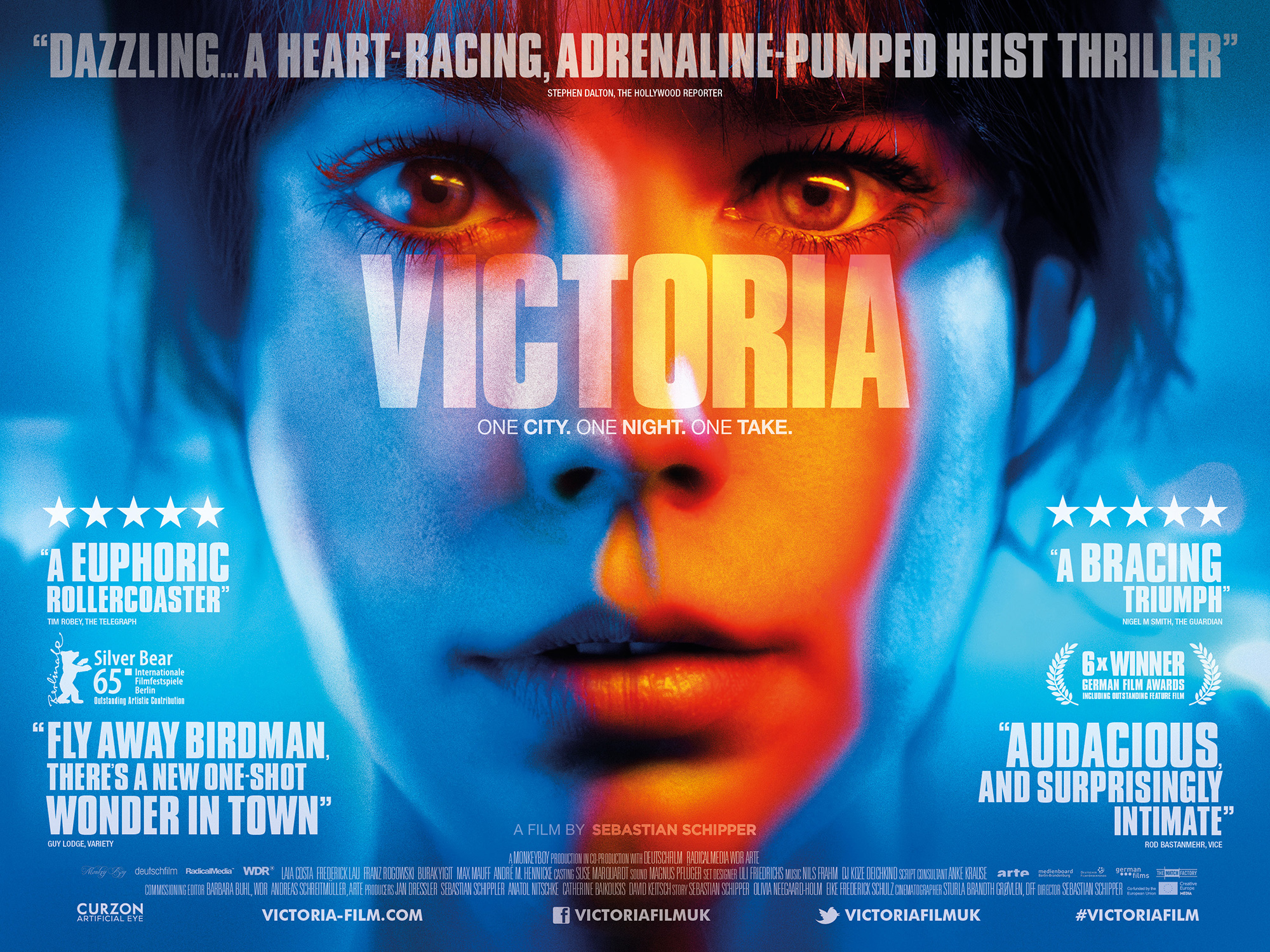
Victoria (Laia Costa) has been living in Berlin for a few months, a Madrid-native, she works in a little cafe and enjoys partying. On a night out she meets a group of men who encourage her to join them for a late party on a rooftop. Before dawn breaks her world is thrown into chaos as she finds herself a participant in a bank heist and faced with deadly consequences.
Sebastian Schipper’s 2 1/2 hour film has been generating quite a buzz since making its debut early in 2015. As it finally hits the UK much has been made about its ambitious running time and completion in one take, and rightly so – this is a brave and bold technical experiment that pays off.
One cannot help but marvel at the ambition of the project. Filmed with one camera in one constantly moving shot, in real time one morning in April 2014 (attempted three times in three nights – this is reportedly the final night’s take), over a large district in Berlin, with improvised performances based around a script that was reportedly no more than 12 pages long. No mean feat.
The performances are solid and convincing, with just enough awkwardness and naturalism (aided by everyone’s broken English) to make proceedings seem real. The camera positions itself throughout as a passive observer – consistently trailing the protagonists, putting the viewer in a ride-along position, an unacknowledged fly-on-the-wall, part-of-but-detached from events.
Directors have been exploring the long-take for as long as cinema has existed, constantly testing the limitations of technology. Past-masters include Scorsese, Welles and Hitchcock. Hitchcock’s Rope (1948) for example was an attempt at a one-take film within the restraints of the time: a reel of film lasted for around ten minutes, and Hitchcock attempts to hide every other break. Had he been able to run for the whole 80 minutes with one mag of film, it seems pretty likely he would have tried. But where Hitchcock and Schipper differ significantly is in their in-camera range. Schipper allows his DP (Sturla Brandth Grøvlen) to approach the visuals in a relatively pedestrian manner – passive, non-invasive, restrained – rather than utilise the camera as a part of the story-telling process. It is only in a handful of specific moments (at the cafe piano, in the car, the hotel room) that the camera dares to break lines and become more inventive. While one applauds the sheer tenacity to keep the camera running, there is some disappointment that the camera couldn’t have been used more ambitiously. A gauntlet thrown for another filmmaker to pick up.
By virtue of the real-time playout we allow for the meandering opening to the film, the long rambling periods during which the characters sound each other out before the drama is unleashed proper. We become Victoria’s conscience, feeling our way through a drunken, pill-enhanced haze, slightly befuddled and easily led by the moment. Once the stakes are raised following an interrupted moment of tenderness at the cafe the film comes into its own, and we’re brought on a heist journey quite unlike anything previously committed to the screen. From there the tension builds, is released, builds again and heads to an unexpectedly honest denouement.
For sheer scale, Victoria begs to be watched and devoured. If it wasn’t for the real-time narrative, I’d be complaining that it slightly overstays its welcome. Similarly, this isn’t the last word in one-take filmmaking, and I hope other filmmakers will push the boundaries further still. A bold experiment.
Victoria
directed by Sebastian Schipper
138 mins, Cert: 15
Language: German / English (with English subtitles)
Released: 1 April 2016 (UK), Artificial Eye.
11 June 2015 (Germany)
In 1962 French critic and director Francois Truffaut spent a week with iconic British director Alfred Hitchcock at Universal Studios in California discussing Hitchcock’s career. The two sparked off a friendship and correspondence that continued until Hitchcock’s death in 1980, and resulted in the interview book Hitchcock/Truffaut. This film, bearing the same title as the book, tells the story of the interview sessions and offers analysis of the importance of the book and Hitchcock’s cinematic legacy.
At 80 minutes, Kent Jones’ documentary provides a fresh and lively look at one of the crucial texts about cinema for any budding film scholar without overstaying its welcome. While many have devoured the pages of the 1966 text (and its subsequent revisions), access to the original interview tapes and previously unpublished behind-the-scenes photographs of the sessions give it an unexpected immediacy. We get a much better feel for the evident mutual affection between the directors, and the dynamics of respect. Often an interviewer is so focussed on getting their own personality across in an interview that they forget to listen to their subject, but Truffaut is a promising filmmaker in his own right, with a couple of pictures under his belt at the time of the recording. Hitchcock isn’t adverse to throwing the questions back on the younger man and interrogate him about his own filmmaking and correcting his methodologies. It really is like a private film school with two of cinema’s greats.
While the book is more detailed, the highlights here are enough to wet the appetite. The use of clips from the films to illustrate the discussion has an advantage over the copious frames in the book – the movement highlights Hitchcock’s sense of camera, pace and rhythm and instill in the viewer a desire to explore more of the master’s work.
Among the discourse between Truffaut and Hitchcock are comments from contemporary filmmakers including Martin Scorsese, Wes Anderson, David Fincher, Peter Bogdanovich, Richard Linklater and Kiyoshi Kurosawa. Their comments stress the importance of the book, but also both filmmakers. The film becomes not quite a making-of, but rather a study of Hitchcock and Truffaut the filmmakers.
The interview in book form can feel terribly formal, but the recordings reveal a more colourful camaraderie. There are ellipses reminiscent of the nouvelle vague’s style of filmmaking – caused by the necessity to edit over 26 hours into the documentary, but also Hitchcock himself stopping the tapes – tantalising glimpses of off-colour anecdotes that only Truffaut was privy to.
Truffaut/Hitchcock by Philippe Halsman. Photo courtesy of Cohen Media Group
The sum experience instills a fresh admiration and love of Hitchcock’s work, and to a lesser extent that of Truffaut. One takes as a central message that in spite of the complexity of Hitchcock’s visuals, there is a sense of less is more – restraint and economy are vital to successful storytelling, and that film scripts shouldn’t need dialogue to tell the story. All too often filmmakers fall into the trap of wordy dialogue over rich visuals, somewhat negating the one thing that sets film apart from theatre.
The book should be a backbone to every film student’s library, and the documentary is an important addition to our understanding of one of cinema’s finest craftsmen. Essential viewing.
There’s plenty written elsewhere on Deadpool‘s slightly troubled journey to the big screen, and the character’s earlier appearance (also by Ryan Reynolds) in X-Men Origins: Wolverine. But for those unfamiliar, Deadpool is something of an anti-hero, a loose ally of the X-Men, set on a brutal path of revenge for the grotesque disfigurement suffered in his transition from human to mutant. His special skill – remarkable ability to heal, rendering him practically immortal.
You’ll also no doubt have heard that Deadpool has become the biggest grossing R-rated film (that’s the US equivalent of our ’18’ certificate, though curiously Deadpool only has a ’15’ rating here) ever released, and was shot on a budget of approximately $58million, about a quarter of the budget for the last X-Men film, Days of Future Past, opening up some interesting possibilities on a series of lower-budget comic-book movies – something which must be tempting for studios.
Regular followers of the Banterflixtv show and podcast will know that I have a reputation for being hard on superhero and comicbook films. I’ve yet to engage properly with the Marvel Cinematic Universe, and still haven’t seen the last Batman film. I mention this because the next few lines will probably surprise some of my colleagues. Deadpool is quite simply brilliant. Enough comic book fantasy to please most, alongside a dark witty script, and a refreshingly self-aware lead.
I’d go further, the rich meta-text that brings Deadpool out of the usual clichés helps shape this as a brilliantly (slightly cynical) cinematic picture. The plot itself is essentially that of avenging a wrong and trying to save the maiden from peril, but its not what’s happening that sets Deadpool aside from its Marvel stablemates, but the way in which its conveyed.
From the off we know that this is a different film – a witty title sequence that depicts Deadpool humiliating a bad guy while instead of the names of the cast and crew, rather more accurate descriptions which lay bare Hollywood’s filmmaking by numbers approach are used “An overpaid tool” etc. Deadpool borrows from its comic convention-crashing approach by giving us a lead character who is aware he’s a work of fiction. He constantly breaks the fourth wall, interacting with the audience and throwing quips which make no sense within the heterogeneous world of the film’s fiction, but which do to those of us in the real world. Use of Hugh Jackman’s face, questioning the timelines of the X-Men movies and the choice of Xavier actors are part of this rich tapestry.
Ryan Reynolds’ acting persona can be a bit marmite, but he embraces that here with enthusiasm and sufficient self-depreciation that ought to win over even his most harshest of critics. Reynolds’ turn makes the film, his personality barely concealed by the leather suit and deeply infectious. His campy stylings throw his enemies and warm viewers; they also hint at a sexual ambiguity present in the character. Deadpool is on record as having a fluid sexuality, something that sets the character out further as part of the alternative counter-culture, though this film does tend towards heteronormative relationships.
Deadpool teaser poster
The lower budget behind the production means that there aren’t as many colossal set pieces as typical for superhero movies, but this is to be welcomed. There’s a point at which one’s suspension of disbelief is sorely tested as cities are ripped asunder time and time again without any consequences to these mutant vigilantes. There’s still plenty of scale and sceptical, but what the film lacks in visual scope it more than makes up for in dialogue.
Ed Skrein makes for an engaging foil, even if he is the latest in a long line of British bad guys in American movies. There’s a sparkle to his playoffs with Reynolds which reminds us of the childlike quality of many cinematic squabbles.
The female members of the cast remain somewhat underused – Morena Baccarin makes for a feisty love interest, but Brianna Hildebrand (Teenage Negasonic Warhead) and Gina Carano (villainous Angel Dust) are powerhouses, but effectively mute making them little more than tools. Considering recent conversations about female characters in sci-fi and fantasy (eg. the Star Wars: The Force Awakens debacle) one would have expected better – particularly as there’s a clever moment of concealment during a fight with Angel. The writers clearly know what’s going on, but while they call it out, they’ve yet to redress it.
Ultimately though, Deadpool is a rich text, and the most interesting comic adaptation in years, rewarding multiple viewings, which has buoyed the coffers of the studio. Deadpool 2 is eagerly awaited, but has much to live up to.
Deadpool is in cinemas now.
Deadpool 108 mins Directed by Tim Miller
Released: 10 February 2016 (UK), 12 February 2016 (US)
With the presence of Kurt Russell in the cast, and a rather violent opening, one might be forgiven for expecting something a little Tarantino with the latest in the Western revivals, but Bone Tomahawk cuts its own path. Part western, part horror, its like a fusion of The Searchers and The Descent, and just as satisfying.
The desecration of a Native American tribal burial ground by Purvis (David Arquette) and companion prompts the brutal, relentless revenge by the ‘primitive’ tribe of troglodytes. An incursion into the nearby town of Bright Hope results in the kidnapping of the snappy female doctor Samantha O’Dwyer (Lili Simmons) and a rescue mission led by reluctant-yet-efficient Sheriff Franklin Hunt (Russell).
We’ve seen the tropes before, and anyone who grew up on early 20th century westerns will recognise them immediately. The Natives are worse than savages (one Native American lives within the civilised town, but even he sees the tribe as something ‘other’), and killing them seems to be the only option for the rescue party. The deputy Chicory (Richard Jenkins) is a bumbling older man who talks too much. The sexy younger man in the fancy suit (Matthew Fox) hides a dark past. The Sheriff’s wife thinks he does too much for the town and should stay at home. The Doctor’s husband (Patrick Wilson) is a stubborn sort who cares only about the safety of his woman, in spite of a temporary physical disability. The female doctor should be an opportunity for a strong woman in the film, but unfortunately Simmons is woefully underused as a totem literally trapped as a result of her own strength and independence.
The plot is overly-familiar. The characters are broad, stereotypes without real depth. But there’s something about the way they’re performed, and the sparse simplicity of the dialogue that sets this apart from the crowd. The use of stillness to ramp up the tension pays off dividends, such that when we end up face to face with the monstrously enhanced villains we overlook the short comings.
Those villains, incidentally are sparsely used, and all the more effective for it. Their torture methods are indeed barbaric, but like the best boogiemen, its when we can’t see them that we really worry.
This isn’t quite the sublime delight that was last year’s Slow West, but in Bone Tomahawk we get an inspired evolution of the genre. S Craig Zahler’s feature debut as director is promising, with a supreme mastery of mood and space. Less is undoubtedly more, with just enough unsettling moments to take this into hybrid-genre territory.
Bone Tomahawk plays at QFT Belfast until 3rd March. Book tickets here.
Bone Tomahawk
133 mins
Writer/Director: S Craig Zahler
Released: 23 October 2015 (US), 19 February 2016 (UK)